
Walk into any premium streetwear boutique in Los Angeles, London, or Melbourne right now and one item dominates the racks: the heavyweight hoodie. Not the thin, flimsy 200 GSM fast-fashion layer that loses shape after three washes. We are talking about the dense, structured, almost jacket-like 400–600 GSM piece that drapes with intention, holds embroidery without puckering, and signals quality before the customer even reads the neck label.
For startup and scaling streetwear brands, the heavyweight hoodie has become the ultimate margin builder. It justifies a higher retail price, commands repeat purchases, and photographs better on social media than any other staple. But manufacturing it correctly requires a factory that understands fabric density, shrinkage control, and decoration compatibility. This guide breaks down exactly what you need to know before you place your first order.
What "Heavyweight" Actually Means: GSM and Fabric Construction
Retailers and factories use GSM (grams per square meter) as the standard weight metric. Most mass-market hoodies sit between 180 and 280 GSM. A true heavyweight hoodie starts at 400 GSM and can reach 600 GSM or higher for ultra-premium drops.
However, GSM alone does not tell the full story. The fabric construction matters just as much:
- French Terry (Loopback) — 400–500 GSM. Looped cotton interior, smooth face. Breathable yet substantial. Ideal for year-round streetwear and the safest choice for first-time heavyweight orders.
- Cross-Grain Fleece — 450–550 GSM. Brushed interior for warmth, tighter knit structure. Excellent for winter drops and skate/workwear aesthetics.
- Double-Faced Fleece — 500–600 GSM. Heavy brushed interior with a clean exterior. Maximum warmth and structure, but requires careful shrinkage testing because the density amplifies any finishing error.
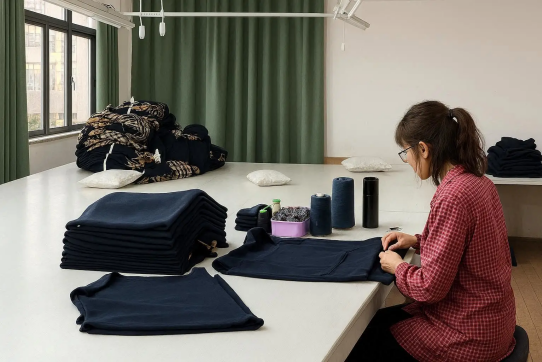
At GuiPing Clothing, we keep all three constructions in ready-to-cut stock within our Guangzhou facility. Because our factory sits five minutes from the city’s fabric hub, we can source custom dye lots or organic cotton blends within 48 hours if your design requires a specific hand feel outside our standard library.
Heavyweight vs. Standard: Why the Upgrade Pays for Itself
Brands often hesitate at the higher unit cost of heavyweight blanks. The math usually resolves in your favor once you factor in customer lifetime value and return rates:
- Perceived value — A 500 GSM hoodie feels like outerwear. Customers willingly pay $80–$120 retail versus $40–$50 for a standard weight piece.
- Durability — Thicker knits resist pilling, seam distortion, and collar stretch. Your brand avoids the one-star reviews that kill DTC brands.
- Decoration stability — Puff print, chenille embroidery, and dense screen prints sit flat and hold their dimension on heavyweight fabric. On thin jersey, the same artwork wrinkles or cracks within weeks.
- Fit retention — Heavyweight cotton has less vertical growth after washing. The silhouette your customer buys is the silhouette they keep.
We have tracked this directly with our clients. Brands that switched from 280 GSM to 450 GSM French Terry saw average return rates drop by roughly 40 percent and repeat order rates increase within two collection cycles.
The Heavyweight Hoodie Factory Checklist: 5 Non-Negotiables
Not every factory that claims "custom hoodies" can execute heavyweight production reliably. Before you send a deposit, verify these five points:
1. Shrinkage Control and Pre-Wash Protocols
Heavyweight cotton shrinks aggressively if the fabric is not pre-shrunk or if the factory skips tension drying. Ask for shrinkage test reports on your exact GSM and fiber blend. At our facility, every heavyweight roll passes a 3 percent maximum shrinkage threshold before it is approved for cutting. If your target is a vintage washed finish, we run the fabric through enzyme washing and tumble drying before pattern grading, not after. That prevents the common trap where a perfectly sized sample becomes a size too small after bulk washing.
2. Needle and Thread Matching
600 GSM fabric destroys standard sewing needles. Factories equipped only for lightweight fashion production will experience broken needles, skipped stitches, and seam blowouts. We run heavyweight orders on DB x 1 #18 needles with T-80 to T-100 bonded polyester thread, and we adjust feed dog pressure to prevent fabric slippage during armhole and hood attachment. These are invisible details that determine whether your hoodie lasts two seasons or two years.
3. Decoration Compatibility Testing
Heavyweight fabric behaves differently under heat and pressure. Puff print requires lower cure temperatures but longer dwell times to avoid collapsing the foam. Chenille embroidery needs wider satin stitch coverage because the dense ground fabric pushes the yarn outward. DTG pretreatment saturates differently on 500 GSM French Terry than on 180 GSM ringspun cotton.
We run a free decoration compatibility test on every new heavyweight artwork file. Our sample room produces a 30 x 30 cm test swatch with your exact print or embroidery parameters so you can wash it three times and inspect before approving bulk. This step alone has saved our clients from thousand-dollar misprints.
4. Pattern Grading for Oversized Silhouettes
The current streetwear market demands oversized, boxy, and drop-shoulder fits. Heavyweight fabric adds bulk, so a pattern that works in 280 GSM will look stiff and tent-like in 500 GSM if the armhole depth and body length are not adjusted. Our pattern team grades heavyweight silhouettes with reduced sleeve cap ease and extended shoulder slopes to maintain the intended drape without creating a cardboard effect.
5. Low MOQ Without Fabric Surcharges
Many factories accept 100-piece orders but quietly add a "small batch surcharge" because heavyweight fabric comes in 25–30 kg rolls instead of the 15 kg rolls used for standard knits. We absorb this through our local stock program. Because we maintain pre-ordered heavyweight rolls in our warehouse, your 100-piece minimum incurs no fabric surcharge and no 30-day fabric-sourcing delay.
Which Custom Techniques Work Best on Heavyweight Hoodies?
Once you have the right blank, the decoration defines your brand identity. Here are the techniques we recommend for 400–600 GSM construction, ranked by durability and visual impact:
- 3D Puff Print — The density of heavyweight cotton supports the foam expansion without sinking. We recommend a 2.5–3.0 mm puff height on 450 GSM+ fabric for maximum dimensional pop.
- Chenille Patches & Embroidery — The stable ground fabric prevents puckering around dense stitch counts. This is the technique that separates boutique streetwear from mall brands.
- High-Density Screen Print — Up to six-color spot printing with a soft-hand base layer. The thick fabric prevents the "plastic board" feel that ruins prints on lightweight hoodies.
- Vintage Wash & Acid Wash — Heavyweight French Terry responds beautifully to garment washing. The surface breaks in with a subtle fuzz, and the seams develop authentic contrast fading that customers pay a premium for.
- All-Over Sublimation (Poly-Blend Heavyweight) — On 400 GSM poly-cotton fleece, sublimation achieves edge-to-edge photorealistic prints without the hand-feel penalty of thick plastisol.
We advise against standard heat-transfer vinyl on 500 GSM+ cotton unless it is a cast PU film rated for thermal expansion. Cheaper vinyl lifts at the edges after the first wash on dense ground fabric. If your design requires a vinyl look, we substitute with silicone-based heat seal that bonds molecularly with heavyweight fibers.
From Sample to Bulk: The Heavyweight Production Timeline
Heavyweight orders do not need to take longer than standard blanks if the factory is properly equipped. Our timeline for custom heavyweight hoodies:
- Day 1 — You submit artwork, reference images, or a tech pack. We return a 3D digital mock-up and fabric recommendation within 24 hours.
- Day 2–6 — We cut and sew your physical sample, including your chosen decoration technique and wash finish. Express courier delivers it to your door for fit and wash testing.
- Day 7–20 — Upon sample approval, bulk production runs across our three dedicated lines. Heavyweight orders are sequenced on machines with adjusted presser foot pressure and extended stitch beds to maintain consistency.
- Day 21–23 — Final QC: every hoodie is checked for seam alignment, cuff symmetry, drawstring length, and decoration adhesion. We then pack with your custom neck labels, hangtags, and poly bags.
- Day 24–30 — DDP door-to-door shipping to USA, EU, or Australia. Customs clearance and duties prepaid. You receive tracking before the container leaves our dock.
Rush capacity is available: 1,000 heavyweight units in 7 days when pre-approved fabric is already in-house.
Private Label and Packaging for Heavyweight Drops
Heavyweight hoodies command a premium unboxing experience. We offer full private-label integration even at 100-piece minimums:
- Woven neck labels — High-density damask woven labels that do not irritate skin under the weight of a 500 GSM hood.
- Custom drawstring tips — Metal aglets, embossed rubber tips, or color-matched cord ends with your logo.
- Branded poly mailers or retail boxes — Heavyweight garments ship better in structured packaging to prevent corner creasing during transit.
- 30-day free warehousing — Store bulk inventory at our Guangzhou facility and release smaller shipments to your 3PL or crowdfunding backers on demand.
Certifications and Transparency
Our facility is BSCI and SEDEX audited, and we execute NDAs as standard practice for every client. Heavyweight fabric sourcing involves higher material costs, so financial transparency matters. We provide itemized costing sheets showing fabric consumption per size, decoration setup fees, and shipping rates—no hidden middleman markups.
We also welcome live video factory tours focused specifically on our heavyweight production line. You can inspect our needle inventory, fabric shrinkage testing station, and puff-print curing ovens in real time before committing to an order.
Why Brands Choose GuiPing for Heavyweight Streetwear
Over the past two decades, we have manufactured heavyweight collections for more than 1,000 brands across the USA, EU, and Australia. Our location in Guangzhou gives us same-day access to 20,000+ fabric suppliers, which means we can prototype a new 550 GSM custom colorway while competitors are still waiting for fabric swatches to clear customs.
We do not treat heavyweight hoodies as a premium upsell. They are a core competency. From 400 GSM French Terry starter blanks to 600 GSM double-fleece winter drops, we have the machinery, fabric stock, and pattern expertise to deliver consistent quality at startup-friendly volumes.
Start Your Heavyweight Collection
Whether you are launching your first oversized 500 GSM drop or scaling a proven heavyweight silhouette to 10,000 units, the factory you choose determines whether your customers become repeat buyers or one-time experimenters.
Get your free sample started today:
- Free 3D mock-up and tech pack within 24 hours
- 100-piece MOQ with no fabric surcharge on heavyweight stock
- Decoration compatibility testing included
- DDP shipping to USA, EU, and Australia
Contact Mike & Request Your Heavyweight Sample →
GuiPing Clothing — Guangzhou's Heavyweight Hoodie Manufacturer Since 2005.